
Cours en ligne
THE PATH TO AWAKENING
| Ce document ne peut être vendu ou cédé à des tiers, ni reproduit sur quelque support que ce soit, même partiellement, sans autorisation écrite de l’auteur. En aucun cas la responsabilité de l’auteur ne saurait être engagée, la mise en œuvre de ce contenu restant sous l'entière responsabilité du lecteur. L'ensemble de ce contenu reste une pratique de bien-être et de prévention, n'ayant aucune vocation médicale. |
Exploring Buddhism

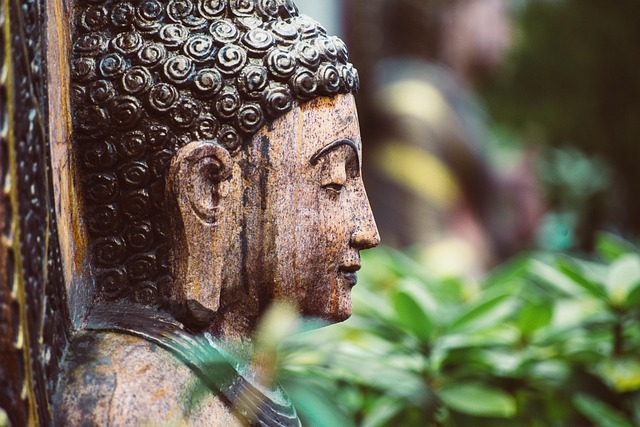 Siddhartha Gautama, known as the Buddha, was born around 563 BCE into a royal family.
At the age of 29, he renounced princely life to seek an answer to human suffering.
After several years of ascetic practice, reflection, and meditation, he realized awakening, thus giving rise to the teachings of Buddhism, which are now several millennia old.
1. Afflictions (Duḥkha) and the Cycle of Rebirths (Samsara)
Dependent Arising (Pratītyasamutpāda)
The Buddha observed that nothing arises without a cause. Indeed, everything finds its origin in prior causes. This is the law of cause and effect.
Moreover, this applies as much to matter as to that which animates matter—personality, emotions, thoughts, beliefs, ego, and so on.
For example: mountains arise because tectonic plates collide; under the influence of anger, the body tenses and relationships become conflicted; you are present here because a force led you to sign up, and so on.
It is worth noting that science reaches the same conclusion: nothing arises without conditions.
However, this is not a fatalistic or deterministic doctrine. We are the product of causes, certainly, but we can also consciously create new ones.
It is precisely in this space that freedom appears.
Impermanence of Reality (Anitya) and Emptiness (Śūnyatā)
 Not only does nothing arise without a cause, but everything has been in constant transformation for billions of years.
For example, this apple that has fallen from the tree will decompose and nourish the soil. The emotion we feel in this very moment will vanish within seconds. Even the mountain that seems eternal will eventually erode under the force of wind or rain.
This is Lavoisier’s famous principle: “Nothing is lost, nothing is created, everything is transformed.”
Not only is everything impermanent, but everything is also empty. Why? Because matter is composed of 99.99% emptiness. We believe the mountain is solid because the electrons in our hand push against the electrons in the mountain. This apparent solidity is therefore electromagnetic, not material.
Surprisingly, the Buddha had already understood these scientific truths some 500 years before our era.
In summary: everything that appears tangible, solid, and unchanging is in fact a persistent illusion that we believe in as firmly as in a dream.
The “self” is a mental construct that does not exist permanently (anātman)
From the very beginning, everything encourages us to believe that we are an individual among many: our body, our name, our desires, our thoughts, our emotions, our beliefs, our personality… This seemingly undeniable “self” has been woven over the course of our own history, like ivy entwining itself around a stone.
Yet our body ages, our emotions pass, our thoughts drift away, we change our minds countless times, and our personality continually evolves.
 Even our consciousness sometimes seems to disappear: where does the “self” go when we sleep, when we lose consciousness, or when we are struck by illness (psychosis, Alzheimer’s, etc.)?
In the end, when we look closely at who we are, we never find a stable “self,” only processes of identification whose origins are conditioned.
So, if everything crumbles, if everything eventually disappears, what remains to say “I”?
The Buddha answers this question decisively: “There is no fixed, eternal, or independent entity that is ‘I.’”
How is this possible? Is our individual self, then, like the mountains: a persistent illusion? Empty and impermanent? Are we a person, or are we no one at all?
This touches a sensitive point for those of us on a spiritual path. Indeed, how could we not believe in our own existence? Is it even possible to imagine?
Here we see that Buddhism proposes a belief that is diametrically opposed to most religions or spiritualities: the absence of a “self” or individual consciousness versus the soul that survives after death.
The Three Poisons (triviṣa)
According to the Buddha’s teaching, three root causes give rise to afflictions:
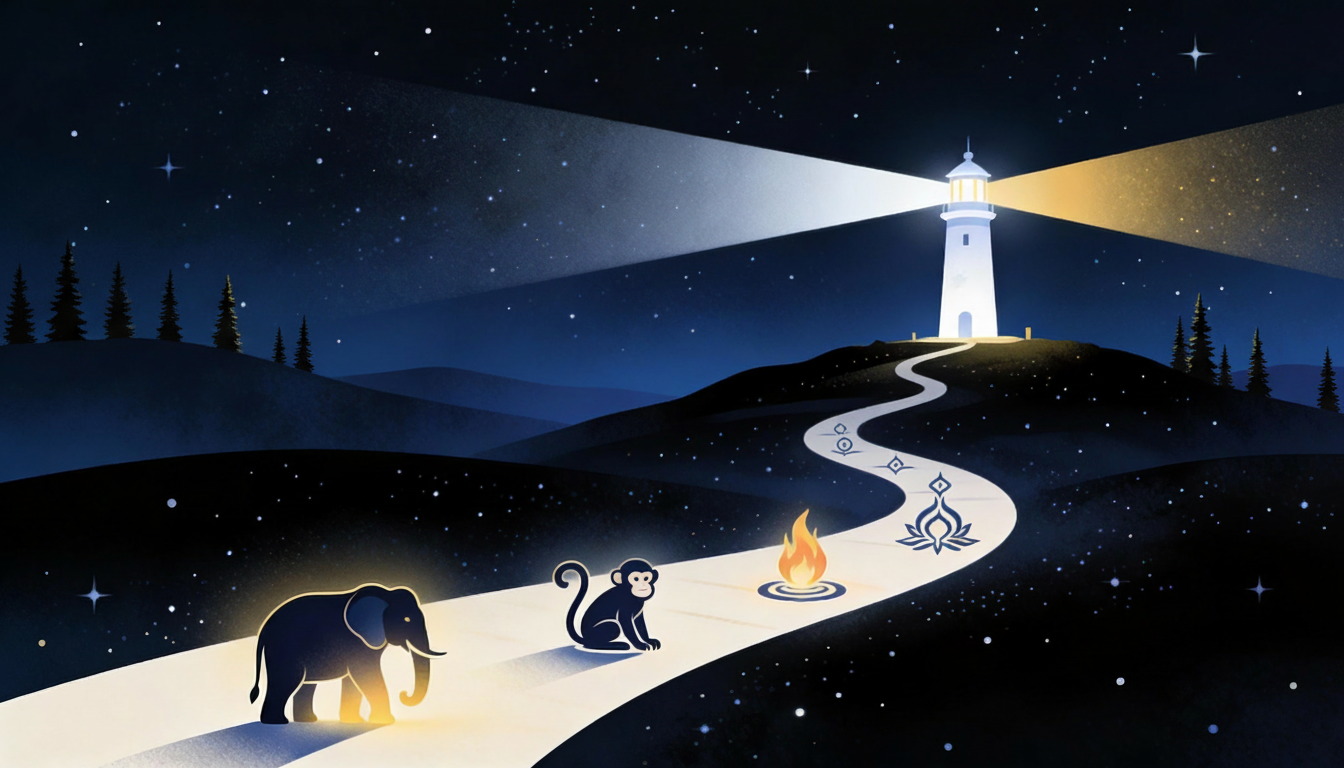
Ignorance (symbol: the pig/mammal): a lack of understanding of the law of cause and effect and a failure to recognize the impermanence of reality. For example: not considering the consequences of one’s actions, identifying with a permanent and solid “self” (spending a lifetime trying to be someone), or being convinced that the mountain is immovable and solid.
Attachment / Greed (symbol: the rooster/bird): constant and unsatisfied desire. For example: making the accumulation of wealth a life goal, being emotionally dependent on someone, being blinded by the entertainment industry, constantly seeking an emotion to feel alive, overindulging in food or culture…
Aversion / Anger (symbol: the snake/reptile): hostility toward what is perceived as harmful. Any thought that reinforces the belief that we are different and separate from one another. For example: all forms of racism, rivalry, jealousy, distrust… Refusing to forgive, considering oneself superior to others, and so on.
Afflictions Condemn Everyone to the Endless Cycle of Suffering (Samsāra)
 Samsāra refers to the endless cycle of everything that arises from a prior cause. There is no distinction or moral judgment here: this karmic wheel includes all that exists, whether material or immaterial, whether perceived as positive or negative.
In practical terms, as long as we remain under the influence of the three poisons, we generate a flow of causes and effects (Saṃskāra) that feeds the endless cycle of suffering.
Of course, there are moments of respite, but they are deceptive. Happiness, for example, slips through our fingers because it is like everything else: impermanent. As long as we seek it, as long as we try to hold onto it, we remain trapped in Samsāra.
Entering the Stream of Awakening (Srotāpatti)
We have seen that:
- The “self” is a mental construct that has no independent existence (Anātman).
- The world around us is a persistent illusion. We perceive it as stable, even though it is constantly changing (Anitya).
- Since the Big Bang, everything—absolutely everything—exists as the result of prior causes, yet we are not aware of all the conditioned flows.
When we realize all of this and believe it without a shadow of doubt, something extraordinary happens. Like a star drawn toward a black hole, we become irreversibly oriented toward awakening (Srotāpanna).
From a psychological perspective, Srotāpatti is therefore a profound reorganization of the cognitive structure. The discovery that there is no “self” at the center of experience disrupts the process of identification: the personality remains, but the “self” crumbles, even collapses. Incredulous, the srotāpanna realizes that experience continues without “him,” and that it has always been this way.
 From that moment, the srotāpanna understands that thoughts and emotions are not produced by the “self” but exist independently. They realize that the body does not need a “self” to breathe or digest on its own.
The lingering doubt about the existence of the “self” no longer holds, and the srotāpanna is freed from a weight that had long burdened their shoulders. This brings an inner calm, renewed trust, and a quieting of the mind. Here is an image that captures perfectly what the srotāpanna experiences.
Imagine a captain who has always believed they were the pilot of the plane. One day, they discover that an “autopilot” mode exists: the plane flies according to physical laws, following predictable reactions that have been conditioned since the beginning. Freed from all responsibility, the captain can now sit back and simply enjoy the journey.
More precisely, the pilot can still sit in the cockpit, but no matter what they do, the plane can fly without them.
Of course, Srotāpatti is not full awakening, far from it. It is a transitional phase in which the srotāpanna continues to live like an ordinary person, influenced by prior conditions. They still experience anger, desire, and all kinds of afflictions.
The next section describes the conditions that lead to complete awakening.
2. Awakening (Bodhi) and the Cessation of Afflictions (Nirvāṇa)
The Nature of Buddha
The entire teaching of the Buddha rests on the understanding of this crucial point: we are already awakened.
Indeed, we have always been awake, but this nature is simply hidden by the thick fog of our mind—our thoughts, our emotions—and by the obsession with the “self” to which we are so strongly attached.
Awakening is therefore not a quest. It is not a state to be sought elsewhere. Rather, it should be seen as a realization, an unveiling, a revelation.
Without understanding this fundamental reality, awakening is impossible, for the already-awake being searches everywhere for a path that does not exist.
Seeking awakening is like spending a lifetime looking for your glasses while they are already on your nose.
Tranquility of Mind (Samatha), Clarity (Vipashyanā), and the Teaching (Dharma) as the Foundations of Awakening
 When we are under the grip of afflictions—anger, fear, sadness, greed, jealousy, pride, arrogance, lack, and so on—it is impossible to realize that another reality exists beyond the “self.” Restoring the tranquility of mind is therefore essential.
When we cling firmly to the persistent illusion of everything around us, including the illusion of our own “self,” it is impossible to perceive what lies beyond it. Attaining clarity becomes crucial.
Finally, the teaching—or the master—allows the one who possesses both tranquility and clarity to realize that they are already awakened. In other words, it reflects their true nature back to them, like a mirror.
Without these three conditions, full awakening is impossible. This triad lies at the very heart of the Buddha’s teaching.
The Nature of Awakeness (Citta-tā)
When we manage to disidentify from the “self,” we realize that something else lies beyond it: Awareness.
So, what is Awareness?
It is what appears when we calmly observe what is happening here and now: a presence that is stable, clear, and serene.
Stable, because Awareness is always present, unlike the “self,” which is impermanent by nature.
Clear, because Awareness recognizes, at every moment, the persistent illusion. It cannot be deceived by what seems permanent, unlike the “self,” which clings to it.
Serene, because Awareness cannot be disturbed, unlike the “self.”
The image of the sun helps us understand the nature of Awareness: clouds may obscure it or let the light through; they may bring lightning, snow, or rain… But once the clouds pass, the sun always shines again.
Here we see that the “self” appears to coexist with Awareness. More precisely, it is an emanation of it, just like thoughts, emotions, or even mountains.
In other words, just as a wave exists without ever being separate from the ocean, the “self” exists without ever being separate from Awareness.
The Cessation of Afflictions (Nirvāṇa)
When we realize that we are already awakened, we stop seeing reality through the eyes of the “self.” We see it directly through Awareness.
From that moment on, we become aware, at every instant, that we are not this “self.” We realize, with astonishment, that it is Awareness that generates thoughts and emotions, not us. That the entire backdrop of the world around us is a persistent illusion arising from the manifestation of Awareness.
Practically, What Does This Change?
Before awakening, we had only the “self” to grasp reality. As we have seen, this “self” clings to concepts, to what it believes to be stable and permanent. But being deceived by impermanence, it generates all kinds of afflictions and constructs: lack, greed, fear…
In the awakened state, the agitation of the “self” calms, as it is no longer at the forefront of what we experience. Even better, we can choose when it appears and for what purpose—like putting on a costume to play a role.
Since our “self” now appears only at the right time, we stop feeding the karmic wheel with actions that produce negativity. The flow of afflictions, arising from past causes and their effects, gradually begins to dry up. Step by step, we leave Samsara behind.
The Intermediate States of Consciousness at the Moment of Death (Bardo)

As we have seen, everything that exists is driven by the uninterrupted force of causes and effects since the Big Bang. These flows (or continuum) carry absolutely everything in their dance. The apple falls from the tree and nourishes the soil. This fertile ground becomes perfect for a flower to grow. And thanks to the wind, there will be a thousand other flowers across the world.
Of course, we are not exempt from this rule: our body, our thoughts, our emotions, our personality… everything that we are is constantly changing, carried along by an infinite number of prior causes.
Like water slipping through our fingers, we do not know where the flow of our own mindstream will take us.
But then, what truly remains of us at the moment of death?
In the Bardo Thödol, the Tibetan Book of the Dead, it is said that we continue to perceive the manifestations of the mind even after death.
A remarkable light may appear, a state of love and peace may envelop us, and beings dear to us may manifest. If our mindstream is troubled, however, a threatening scene may also appear: terrifying shapes, entities, strange sounds…
These phenomena correspond to what many people report during near-death experiences (NDEs). Yet, according to the Bardo Thödol, this environment is only a persistent illusion—a pure projection of the mind—and it must not be clung to.
Why? Because if we firmly believe that the mind’s manifestations are reality, we become like prisoners of a vivid dream. But the dream will dissolve, and our mindstream will be drawn toward a new body, a new birth, a new “self.”
In this regard, there are numerous accounts of young children who claim to remember a previous life. Some even describe how the continuum of their former “self” dissolves until their rebirth into a new body.
For all beings who reincarnate, the manifestations of the mind—thoughts, emotions, the persistent illusion of the earthly environment—quickly allow a new “self” to take root. This is why, by around the age of nine, these children retain no memory of their past life, and thus of their former “self.”
We can see that even beyond death, our individual consciousness is not exempt from the conditioned cycle of causes and effects (Samsara). Only the nature of the Buddha allows one to stop the systematic identification with a “self” and thereby escape the cycle of reincarnation.
In other words, when we realize that we are already awakened, the “self” has no reason to exist. And like a flame with no fuel, it eventually goes out.
Here we see that the implications of awakening are truly dizzying.