
Cours en ligne
THE PATH TO AWAKENING
| Ce document ne peut être vendu ou cédé à des tiers, ni reproduit sur quelque support que ce soit, même partiellement, sans autorisation écrite de l’auteur. En aucun cas la responsabilité de l’auteur ne saurait être engagée, la mise en œuvre de ce contenu restant sous l'entière responsabilité du lecteur. L'ensemble de ce contenu reste une pratique de bien-être et de prévention, n'ayant aucune vocation médicale. |
The True Nature of Awareness
This drawing and its detailed explanations show the path to follow to realize awakening
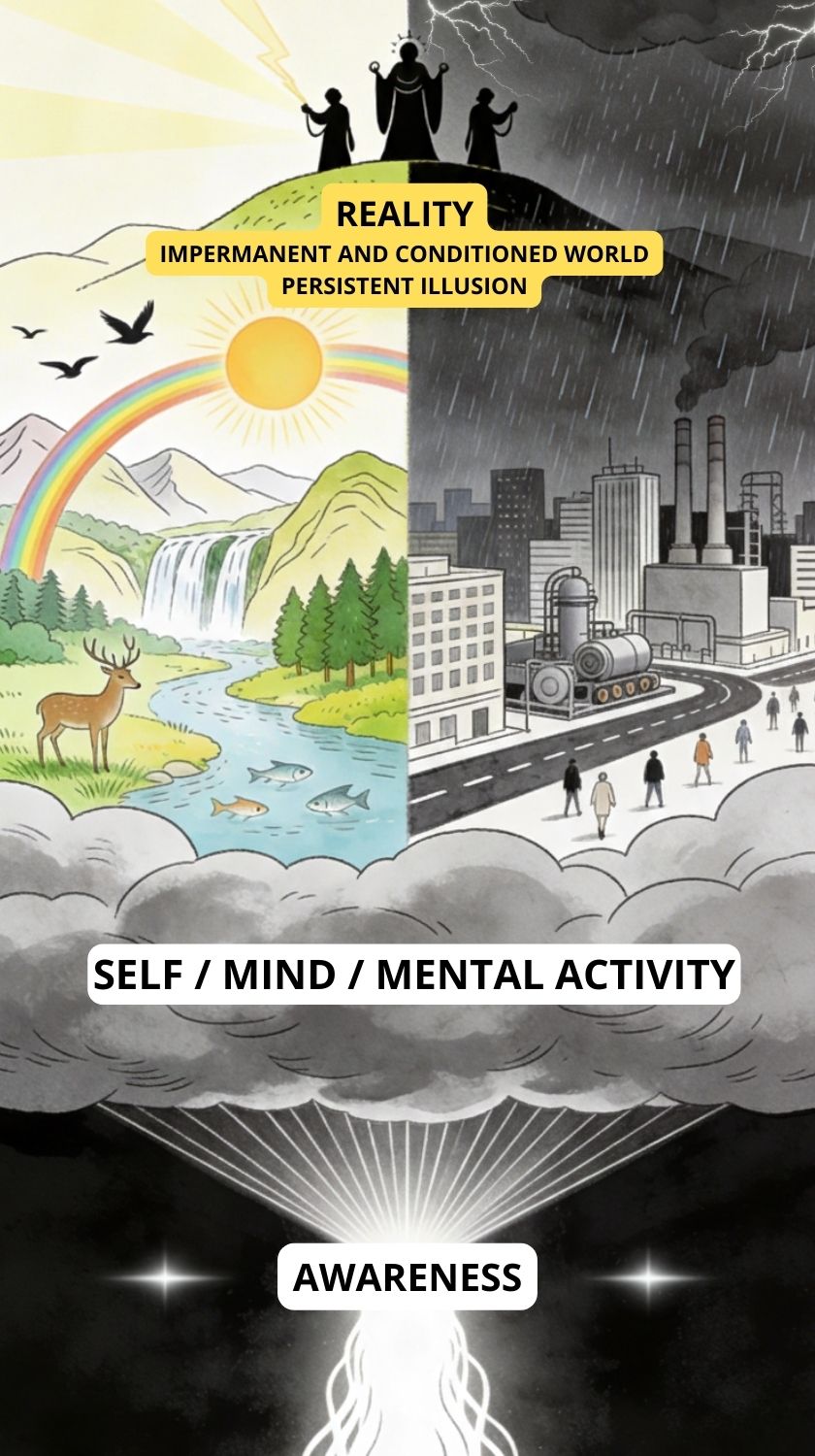 The drawing consists of three panels:
Awareness is the emptiness that connects everything that exists. Since we are all connected to it, Awareness is therefore our shared nature.
The fog symbolizes identification with the "self" and the restless mind (negative thoughts and emotions). Because of it, we are cut off from our true nature. We no longer perceive reality through Awareness.
We see the world through the filter of our mind and the "self" with which we identify. This world appears stable and solid to us. Yet, it is impermanent: it is constantly changing due to prior causes and conditions. What we perceive of the world is therefore a persistent illusion.
How can awakening be realized?
The first step is to clear the fog of the mind, bringing an end to mental afflictions.
The second step is to disidentify from the "self", allowing it to recede into the background of experience.
The third step is to perceive the world through awareness, as it truly is: impermanent and conditioned.
What is the nature of Awareness?
By nature, Awareness is a presence that is empty, calm, and stable. To recognize this, it is enough to sit quietly for a few moments, without engaging in thought or setting any intention to observe.
One may notice that the “self” fades away, yet experience continues.
In the temporary absence of the “self,” there remains something empty, calm, and stable. This is the nature of Awareness.
It is important to emphasize that we are simply observing what is, without trying to form concepts or activate the mind. This is why we can speak of the nature of awareness—we are not attempting to define or conceptualize it.
By contrast, we can clarify what Awareness is not: it is not the mind (thoughts and emotions). It is neither the “self,” nor the ego, nor individual consciousness, nor personality, nor identity.
To go further:
In the drawing, we can see gods at the top of the hill. According to Buddhist teachings, these deities are fully part of the impermanent and conditioned world.
More precisely, gods are like us: they are not eternal and eventually pass away, although on a different timescale. They remain subject to the law of cause and effect, even though they do not possess a physical body and no longer experience negative states.
However, this does not prevent them from helping us, as they have the capacity to do so.