
Cours en ligne
THE PATH TO AWAKENING
| Ce document ne peut être vendu ou cédé à des tiers, ni reproduit sur quelque support que ce soit, même partiellement, sans autorisation écrite de l’auteur. En aucun cas la responsabilité de l’auteur ne saurait être engagée, la mise en œuvre de ce contenu restant sous l'entière responsabilité du lecteur. L'ensemble de ce contenu reste une pratique de bien-être et de prévention, n'ayant aucune vocation médicale. |
Truth is a pathless land

What is Spirituality?
Everyone projects something unique onto every word. If I speak of love, for instance, what images or feelings arise within you?

If I speak of spirituality… what thoughts come to mind?
For many, spirituality is the way one lives their relationship with God—true for those on religious paths, whether Christian, Muslim, or Hindu.
For others, it is a framework for explaining the meaning of life, the workings of the universe, and what lies beyond the visible. This often takes the form of elaborate theories: the law of attraction, life missions, the existence of the soul, angels and guides, twin flames…
Here we touch on what is commonly called “New Age” spirituality, which has become very popular in the West.
And yet, for some, spirituality is simply faith: a personal inner strength to rely on when life shifts or falters, sometimes without the need to belong to a religious community.
The Six Blind Men and the Elephant
Whether religious, spiritual, or atheist, one truth remains: no one can claim to hold absolute truth, for such a claim risks falling into sectarianism.
If an ultimate reality exists, it surely transcends us, and we perceive only a small fragment of it, shaped by our own perspective.
I invite you to explore this idea through a traditional Hindu tale.

Jiddu Krishnamurti
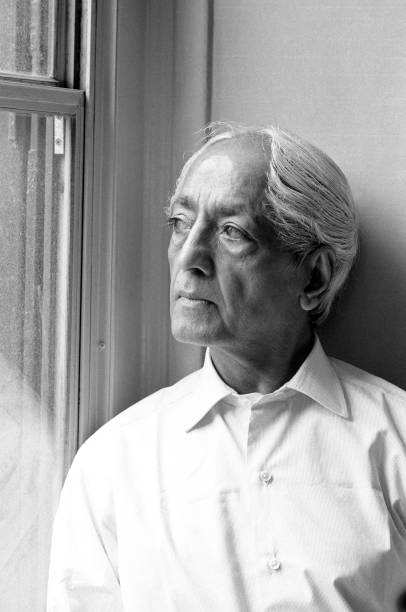 Some great masters have taught beyond dogma, community, or religion. One of the most remarkable is Jiddu Krishnamurti, a 20th-century Indian philosopher, whom I invite you to discover.
Krishnamurti was born in 1895 in southern India, into a modest family. At the age of 14, while playing on a beach with his brother, he encountered Charles Leadbeater and Annie Besant, leaders of the influential Western spiritual organization, the Theosophical Society.
It is said that upon seeing the boy, Leadbeater exclaimed: "There is no trace of ego in this boy’s aura! He is therefore the Vehicle of the World Teacher!"
Convinced they had found the messiah they had long awaited, Leadbeater and Besant adopted Krishnamurti and educated him in London to one day lead the Theosophical Society.
Yet Krishnamurti possessed an extraordinary independence of mind, shaped by a difficult childhood and fragile health. The deeper he explored mystical teachings, the more he rejected the notion of being the awaited messiah.
In 1929, he addressed an assembly of followers and dissolved the very organization he had been destined to lead. He famously declared: "Truth is a pathless land."
From that moment, he taught freely around the world—without disciples, without religion, without system—until his death in 1986.
On Religions and Dogmas:
Truth is a pathless land. It cannot be approached by any path, by any religion, or by any sect. Truth, being limitless, unconditioned, and beyond reach, cannot be organized; no organization should attempt to lead or coerce people along a particular way.
To understand this is to see the impossibility of organizing faith. Faith is a personal matter—intimate, unbounded. If one tries to structure it, it hardens into belief, imposed upon others, losing its freedom.
Hindus, Christians, Muslims—they are all conditioned. There is no freedom in that conditioning. It divides them. Across the world, people are the same, yet society pits them against one another—by nationality, by culture. Wherever division exists, conflict and violence follow. Should we not then strive to decondition the mind?
To do so, one must cultivate attentive awareness: a careful watchfulness of all that arises, without choosing, without letting thought impose itself. If a person can reach such a state, they can maintain it, abiding beyond the confines of time.
Time brings division and movement; it is a creation of thought. Attention, by contrast, is more real than time—it is boundless. When we live fully in this state of attention, we create unity within ourselves and with all things.
Speech by Jiddu Krishnamurti - 1929